When a dog experiences a spinal cord injury—whether from intervertebral disc disease (IVDD), fibrocartilaginous embolism (FCE), spinal fracture, or trauma such as a motor vehicle accident or fall—recovery is about far more than simply waiting for damaged tissues and nerves to heal.
One of the nervous system's most remarkable abilities is neuroplasticity: its capacity to adapt and reorganise in response to injury and experience. [1,2]
Physiotherapy aims to harness this ability through targeted and purposeful rehabilitation. Rather than simply encouraging a dog to move more, we want to help the nervous system relearn healthy, efficient and coordinated movement patterns. [2–5]
What is neuroplasticity?
Neuroplasticity describes the nervous system's ability to change in response to experience. It is fundamental to learning in a healthy nervous system and relearning following neurological injury. [1]
Following injury to the spinal cord, communication between the brain and body may be disrupted. The nervous system can undergo considerable reorganisation after injury, and appropriately designed rehabilitation provides repeated sensory and motor experiences that may help influence this process. [1,2,12]
A useful way to think about this is as a road network.
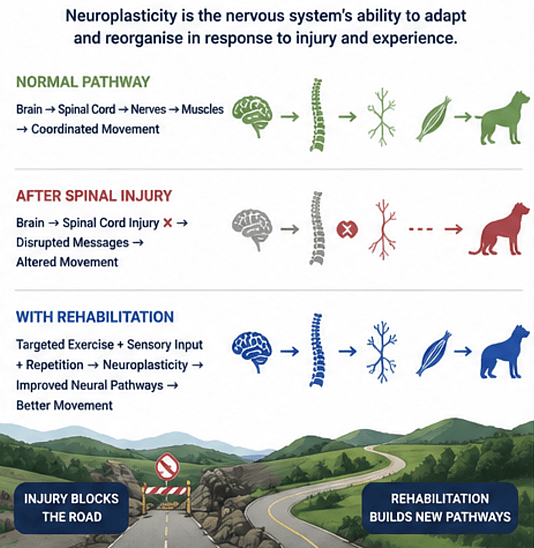
If a major highway is damaged, traffic has to find another route. Some alternative routes are efficient, while others involve unnecessary detours. In neurological rehabilitation, we aim to encourage the nervous system to repeatedly practise useful movement strategies so that the most efficient pathways possible are reinforced.
Importantly, neuroplasticity is experience-dependent. Principles identified in neurological rehabilitation include use it and improve it, specificity, repetition and intensity. [1] Exercise and activity can also influence cellular and molecular pathways involved in plasticity and motor recovery following spinal cord injury. [12]
Key message: Recovery following a spinal injury is not simply about healing damaged tissue. It is also about helping the nervous system relearn how to move. [1,2,12]
Why do the first three months matter?
The early weeks and months following spinal cord injury are an important period for neurological recovery and rehabilitation. [2,3]
Recovery is often most rapid during the earlier stages after injury, while neuroplasticity and activity-dependent changes within the nervous system provide opportunities for rehabilitation to influence function. [1,2,12]
For this reason, at Optima Animal Physio we consider the first three months an especially valuable rehabilitation period—not a strict biological deadline.
Dogs can continue to make neurological and functional improvements well beyond 12 weeks. However, the early recovery period provides an important opportunity to establish appropriate movement patterns and minimise the development of unnecessary compensation.
Early rehabilitation may focus on:
encouraging appropriate weight-bearing
maintaining joint movement and muscle health
restoring coordinated stepping
improving proprioceptive input
improving balance and postural control
encouraging appropriate muscle activation
reducing reliance on compensatory movement patterns. [2–6]
Importantly, canine research supports the feasibility and safety of structured rehabilitation early after spinal cord injury, although the optimal type, intensity and frequency of rehabilitation are still being investigated.
A randomised prospective study of dogs following surgical decompression for acute thoracolumbar IVDD investigated an intensive postoperative rehabilitation programme beginning during the early recovery period. [3] The programme was safe, although intensive rehabilitation did not significantly accelerate recovery compared with the basic rehabilitation programme in the population studied. [3]
Other canine studies have investigated structured locomotor training, treadmill rehabilitation and sensory-enhanced rehabilitation following spinal cord injury. [4–7]
Key message: The first few months are an important opportunity to guide neurological recovery, but they are not the end of your dog's capacity to improve. [1–7,12]
Walking isn't always "normal" walking
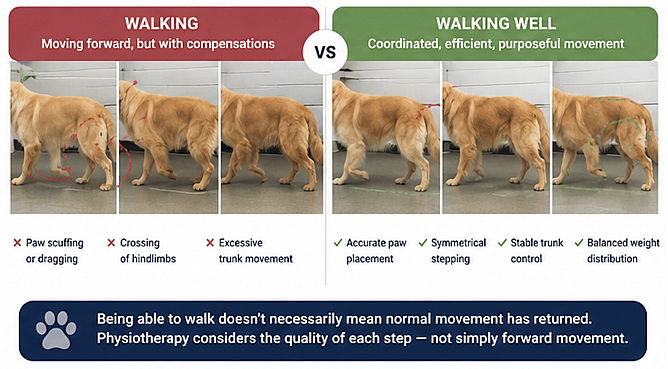
One of the most important concepts for owners to understand is that being able to walk and walking normally are not necessarily the same thing.
After a neurological injury, an animal may learn to accomplish a task through compensation rather than restoring the original movement strategy. The distinction between true motor recovery and compensation is well recognised in neuro-rehabilitation. [8]
In dogs recovering from spinal cord injury, we may see movement patterns such as:
dragging or scuffing the paws
crossing the hindlimbs
exaggerated stepping
circumduction, where the limb swings outwards
excessive movement through the trunk
shifting excessive weight onto the forelimbs
difficulty accurately placing the paws
A dog may therefore regain independent mobility while still having significant deficits in coordination, proprioception, strength or motor control.
This is why our goal in neurological physiotherapy is not simply: "Can this dog walk?"
We also need to ask: "How is this dog walking?"
Canine locomotor rehabilitation research specifically focuses on relearning stepping and improving coordinated locomotion following spinal cord injury. [4–7] Research in dogs with incomplete spinal cord injury has also demonstrated measurable improvements in locomotor function during structured treadmill and over-ground rehabilitation programmes. [5]
Even dogs with severe neurological deficits can develop forms of spinal locomotion, demonstrating the remarkable capacity of spinal neural circuitry to generate and adapt stepping patterns. [7]
Key message: Walking is not the same as walking well. Our aim is to improve the quality of movement, not simply achieve forward movement. [4–8]
How does physiotherapy retrain the nervous system?
Every time a dog stands, shifts weight or takes a step, sensory information travels from the limbs and body back towards the central nervous system.
Information from the muscles, joints, skin and paws contributes to the nervous system's awareness of where the body is positioned and how it is moving.
Neurological physiotherapy uses purposeful, task-specific movement and repetition to repeatedly expose the nervous system to relevant sensory and motor experiences. [1,2,4]
Depending on the individual dog, rehabilitation may therefore focus on:
improving paw placement
encouraging symmetrical weight-bearing
activating appropriate muscle groups
improving balance
improving postural control
improving coordination
practising controlled stepping
reducing reliance on compensatory movement strategies
Canine studies have specifically investigated locomotor training following spinal cord injury, including body-weight-supported treadmill training and conventional over-ground training. [4,5] Sensory-enhanced rehabilitation has also been investigated in dogs following thoracolumbar IVDD, reflecting increasing interest in how sensory information can be incorporated into canine neurological rehabilitation. [6]
What about abnormal muscle tone?
Movement isn't controlled by muscle strength alone.
The brain and spinal cord continuously regulate when muscles activate, how strongly they activate and when they relax.
Following spinal cord injury, normal descending influences over spinal reflex pathways can be disrupted. Changes within spinal circuitry can contribute to hyperreflexia, spasticity and abnormal muscle tone. [9,10]
For some dogs, this may manifest as increased or poorly regulated flexor or extensor activity in the hindlimbs.
Owners may notice a limb that:
becomes unusually stiff
remains excessively extended
pulls strongly into flexion
is difficult to advance normally
produces exaggerated movements
doesn't coordinate appropriately with the other limbs
This is why simply strengthening the hindlimbs isn't necessarily enough.
We want muscles to activate at the appropriate time, in the appropriate sequence and with an appropriate amount of force.
Neurological rehabilitation therefore considers strength alongside sensory feedback, coordination, timing, postural control and movement quality. [2,4,9,10]
Key message: Physiotherapy isn't simply exercise. Neurological physiotherapy uses targeted movement and sensory input to help the nervous system relearn efficient movement. [1,2,4–6,9,10]
Quality matters more than quantity
After a spinal injury, it can be tempting to think: "If walking is good, more walking must be better."
But neurological rehabilitation is not simply about accumulating kilometres.
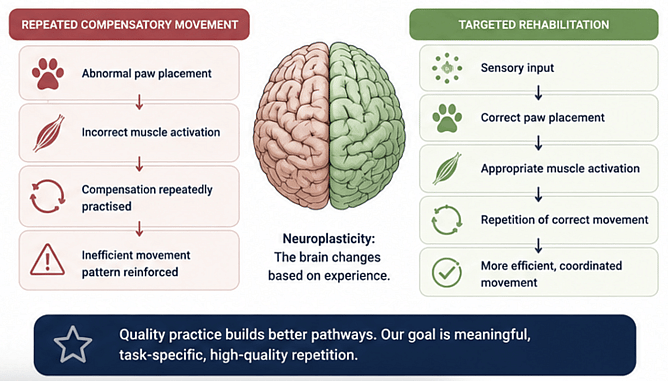
Experience-dependent plasticity is influenced by specificity, repetition and intensity.[1] Activity-based rehabilitation following spinal cord injury similarly emphasises repetitive, task-specific activity designed to engage the neuromuscular system below the level of injury. [11]
At the same time, neurological rehabilitation distinguishes genuine recovery from learning compensatory strategies to accomplish a task. [8]
This means we need to pay close attention to what the dog is repeatedly practising.
If a dog becomes tired and every step involves dragging a paw, swinging a hindlimb, crossing the legs or heavily compensating through the forelimbs, simply asking for more repetitions may not produce the movement quality we are trying to achieve.
Instead, rehabilitation should aim for movement that is as:
controlled
coordinated
symmetrical
purposeful
efficient
as the dog's neurological status allows.
Exercise also needs to be individualised. The appropriate intensity for one dog may be completely inappropriate for another, depending on the location and severity of the spinal injury, surgical or medical management, pain, neurological status and stage of recovery. [2,3]
Key message: The nervous system learns through practice. Our goal is not simply more repetitions—it is meaningful, task-specific, high-quality practice. [1,8,11,12]
The Take-Home Message
Recovery following spinal cord injury is about much more than getting a dog back onto their feet.
It is about helping the nervous system relearn movement.
The early weeks and months after a spinal event provide an important opportunity for targeted rehabilitation. Through appropriate sensory input, repetitive task-specific exercise, locomotor retraining and careful management of compensatory movement patterns, we can aim to maximise each dog's neurological and functional recovery. [1–7,11,12]
Importantly, three months is not the end of recovery. Dogs may continue to make meaningful neurological and functional gains beyond this period. [2,4,7]
At Optima Animal Physio, our goal isn't simply to help dogs walk again.
Our goal is to help them move as well as they possibly can.
References
1. Kleim JA, Jones TA. Principles of experience-dependent neural plasticity: implications for rehabilitation after brain damage. Journal of Speech, Language, and Hearing Research. 2008;51(1):S225–S239.
DOI: 10.1044/1092-4388(2008/018)
2. Frank LR, Roynard PFP. Veterinary neurologic rehabilitation: the rationale for a comprehensive approach. Topics in Companion Animal Medicine. 2018;33(2):49–57.
DOI: 10.1053/j.tcam.2018.04.002
3. Zidan N, Sims C, Fenn J, Williams K, Griffith E, Early PJ, Mariani CL, Muñana KR, Guevar J, Olby NJ. A randomised, blinded, prospective clinical trial of postoperative rehabilitation in dogs after surgical decompression of acute thoracolumbar intervertebral disc herniation. Journal of Veterinary Internal Medicine. 2018;32(3):1133–1144.
DOI: 10.1111/jvim.15086
4. Gouveia D, Cardoso A, Carvalho C, Almeida A, Gamboa Ó, Ferreira A, Martins Â. Approach to small animal neurorehabilitation by locomotor training: an update. Animals. 2022;12(24):3582.
DOI: 10.3390/ani12243582
5. Martins Â, Gouveia D, Cardoso A, Viegas I, Gamboa Ó, Ferreira A. A comparison between body weight-supported treadmill training and conventional over-ground training in dogs with incomplete spinal cord injury. Frontiers in Veterinary Science. 2021;8:597949.
DOI: 10.3389/fvets.2021.597949
6. Lewis MJ, Bowditch J, Laflen B, Perry N, Yoquelet R, Thomovsky SA. Pilot study on feasibility of sensory-enhanced rehabilitation in canine spinal cord injury. Frontiers in Veterinary Science. 2022;9:921471.
DOI: 10.3389/fvets.2022.921471
7. Henea ME, Șindilar EV, Burtan LC, Mihai I, Grecu M, Anton A, Solcan G. Recovery of spinal walking in paraplegic dogs using physiotherapy and supportive devices to maintain the standing position. Animals. 2023;13(8):1398.
DOI: 10.3390/ani13081398
8. Levin MF, Kleim JA, Wolf SL. What do motor "recovery" and "compensation" mean in patients following stroke? Neurorehabilitation and Neural Repair. 2009;23(4):313–319.
DOI: 10.1177/1545968308328727
9. Trompetto C, Marinelli L, Mori L, Pelosin E, Currà A, Molfetta L, Abbruzzese G. Pathophysiology of spasticity: implications for neurorehabilitation. BioMed Research International. 2014;2014:354906.
DOI: 10.1155/2014/354906
10. Adams MM, Hicks AL. Spasticity after spinal cord injury. Spinal Cord. 2005;43:577–586. DOI: 10.1038/sj.sc.3101757
11. Dolbow DR, Gorgey AS, Recio AC, Stiens SA, Curry AC, Sadowsky CL, Gater DR, Martin R, McDonald JW. Activity-based restorative therapies after spinal cord injury: inter-institutional conceptions and perceptions. Aging and Disease. 2015;6(4):254–261.
DOI: 10.14336/AD.2014.1105
12. Bilchak JN, Caron G, Côté MP. Exercise-induced plasticity in signalling pathways involved in motor recovery after spinal cord injury. International Journal of Molecular Sciences. 2021;22(9):4858.
DOI: 10.3390/ijms22094858
Additional veterinary reference:
Millis DL, Levine D, eds. Canine Rehabilitation and Physical Therapy. 3rd ed. Elsevier; 2022.